Modern sports teams have become enormous conglomerates, built into organizational structures made up of multiple specialized departments, with each department generating huge quantities of data. Spend a day with any sports organization, and you will find a performance department staffed by sport scientists constantly measuring physical outputs and monitoring workload ratios, whilst strength coaches are screening movement and mobility, testing speed metrics, and establishing individual force: velocity profiles. In the medical department, staff are documenting every injury and rehabilitation milestone, and in the analysis department experts are poring over stats to identify tactical patterns, analyzing match outputs and coding game footage. Over in the scouting department, recruitment staff are continually evaluating player data across global markets and making benchmark comparisons with the current squad in an attempt to discover the ‘next big thing’. In the technical department, coaches are endlessly refining tactical frameworks and providing player evaluations, whilst in the front office staff are tracking contract values and carefully considering the long-term roster strategy. The sheer volume of data which is being created by every single department on any given day is overwhelming.
Yet for many organizations, this wealth of information rarely reaches the people responsible for the most consequential decisions: General Managers, CFOs, Sporting Directors, ownership groups and the boardroom. Even if it does reach them, it often arrives in the form of dense spreadsheets, specialist terminology, or fragmented reports from different departments, all of which are difficult to interpret. As a result, executives are expected to make high-stakes operational decisions by navigating data designed exclusively for practitioners rather than for leadership. These executives don’t need more data, they need better context, clearer summaries, and insights which put them in a position to make decisions more effectively. At Apollo, we pride ourselves on the relationships that we have generated with our partners who operate at the highest levels of elite sport. It is from these collaborations that we have identified that the gap between performance insight and executive decision-making is one of the most overlooked inefficiencies in elite sport.
And so we created the Apollo ‘Executive Dashboard’ to close it.
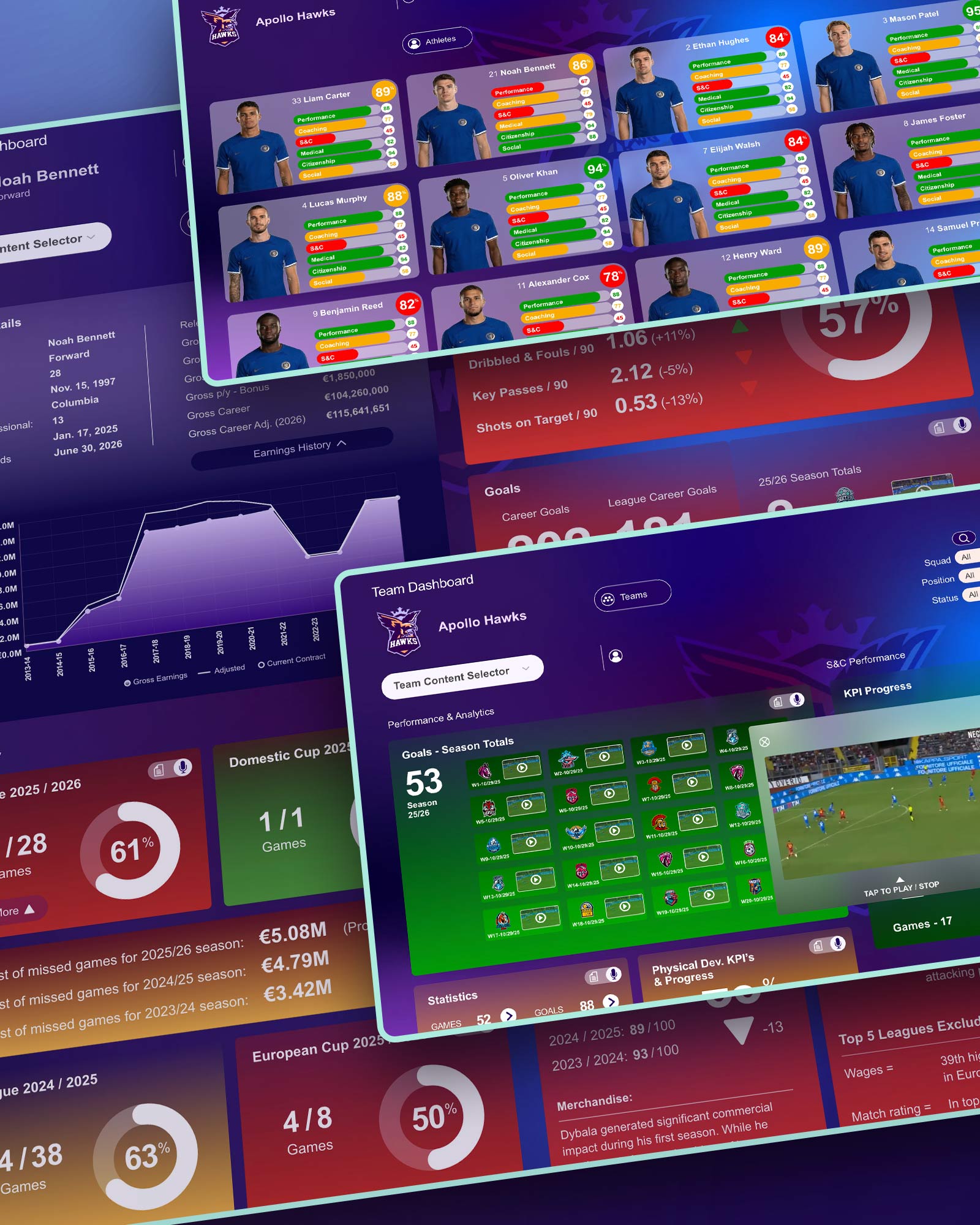
By translating complex performance data into clear, structured, and understandable insights, Apollo ensures that General Managers, CFOs, Sporting Directors and board members can make informed decisions with confidence. It transforms fragmented, specialist data into a unified, intuitive view of performance, athlete availability, value and risk, allowing leadership to make the right calls at the right times.
The Executive Information Gap in Elite Sport
High-performance departments speak a specialized language. Sports scientists discuss training loads and neuromuscular readiness, physiotherapists reference rehabilitation progressions and clinical findings, and analysts present tactical metrics and positional performance indicators. These insights are essential, but despite the fact that General Managers and Sporting Directors rely on data from each department to function effectively, reporting is rarely framed for this executive audience. Executives are required to balance several priorities simultaneously, including financial sustainability, athlete contract negotiations, long-term recruitment strategies, athlete investment and resale value and brand reputation. To make decisions quickly and effectively, they need athlete specific information and performance data from multiple different departments. However, each department uses its own unique vocabulary and terminology, and if this specialized language is not translated clearly and accurately, several problems emerge. Executives may have to rely on incomplete summaries or informal conversations rather than structured data, different departments may provide conflicting interpretations, and critical insights may never reach leadership at all. In an environment where athlete contracts can represent multiple millions in financial investment, decisions based on partial information carry significant risk.
For this reason, data must be presented in a way that the executive audience can comprehend clearly, and which aligns with their strategic objectives rather than the technical methodology of the performance, medical or coaching staff. Apollo’s Executive Dashboard addresses this problem by making performance intelligence accessible to the entire leadership structure, presented in a way that they can easily understand.
A Single View of the Athlete: From Profile to Performance
The core purpose of the Executive Dashboard is simple: translate specialist knowledge into a format that anyone responsible for strategic decision-making can understand immediately.
Instead of presenting raw metrics or technical reports, Apollo organizes data into clear summaries that highlight the information which is most relevant to executive priorities. For this reason, at the center of the Executive Dashboard sits a holistic athlete profile, combining personal, financial, and performance data into a single, structured view.
From this profile, executives can instantly access:
- Playerdemographics and career history
- Contractdetails, including salary, bonuses, and release clauses
- Careerearnings trajectory
- Comparativecompensation scenarios
- Re-signevaluation metrics
- Position,age, and experience
Apollo understands that in elite sport, every performance decision is also a financial decision, therefore considering the investment tied to an athlete is critical when evaluating performance, availability, and long-term value. In this function, one of the most powerful elements of the Executive Dashboard is its ability to support contract decisions. Rather than requiring executives to interpret complex datasets, the dashboard summarizes background information, provides essential context and delivers the conclusions that matter most. This allows leadership to assess whether an athlete’s compensation aligns with performance and availability, calculate what the financial implications of renewing or renegotiating might be, and identify the balance between performance, commercial value, and athlete durability. Instead of relying on isolated reports, executives have all the relevant data available to them in one place, enabling faster and more confident decisions. By placing financial and performance data side by side, the Executive Dashboard ensures that every decision is grounded in both sporting and economic reality.
Athlete Availability: The Metric That Drives Everything
One of the most important performance indicators at the executive level is athlete availability. Regardless of talent or financial investment, athletes cannot contribute if they are unable to play due to injury, meaning that availability directly impacts team performance, roster planning, and financial return. GM’s and Sporting Directors are asking themselves the same question every day; ‘What risk is involved if we recruit (or retain) that player’? All too often, the decision is made on incomplete information.
Apollo’s Executive Dashboard provides leadership with a clear visualization of athlete availability across competitions and seasons, broken down into:
- League and cup participation
- International competitions
- Historical availability trends across multiple seasons
- Games played vs total possible games
- Percentage availability per competition
- Changes in availability over time
High value players with low availability represent both a performance and a financial risk. This data summary provides executives with context for operational decisions such as squad depth, transfer priorities, and resource allocation within performance or medical departments. Apollo’s Executive Dashboard doesn’t just show availability, it quantifies its impact, and in doing so transforms it from being a medical metric into a strategic one.
The Cost of Unavailability: Turning Medical Data into Financial Insight
Related to the issue of athlete availability, one of the most striking elements of the Executive Dashboard is the financial translation of athletes missing competition through injury. Instead of treating injuries or absences as abstract issues, Apollo connects them directly to economic burden by calculating:
- Cost of missed games per season
- Year-on-year injury comparisons
- Projected future cost
This is the point where performance data becomes strategic. Executives can now quickly see exactly how much money each injury is costing the organization, whether the financial burden of athlete injury is improving or declining, and whether the highest-value assets are being managed effectively. By linking performance to financial outcomes in this way, Apollo’s Executive Dashboard ensures that medical and performance insights are fully integrated into future planning and decision-making.
Athlete Injury History and Risk Context
Injury risk is often discussed in a technical language that can be difficult for non-specialists to interpret, the result being that critical information and vital insights are frequently overlooked. The Executive Dashboard reduces the risk of this happening by translating specialized medical data into a clear operational overview. Through the Dashboard, GM’s and Sporting Directors can access concise summaries of:
- Injury history
- Injury recurrence patterns
- Rehabilitation timelines
- Identified medical risk flags
This information is essential when executives are making decisions involving player recruitment, retainment, contracts, wage structure, bonuses and transfers or trades. For example, a player returning from injury may appear ready for competition, but longitudinal medical data may suggest a heightened risk of injury reoccurrence. With the Executive Dashboard, leadership can both identify and understand the status of the athlete within that specific context, before making decisions that have implications both for performance and finance.
By translating specialist data into clear, structured insight, Apollo creates a shared language across the organization which reduces friction, eliminates misinterpretation, and ensures that everyone is working from the same level of understanding.
Longitudinal Performance Data: Seeing the Bigger Picture
Individual performance metrics are useful in isolation, but the real value emerges when they are tracked over time. Apollo’s Executive Dashboard allows executives to view longitudinal athlete performance trends in a clear, digestible format. Instead of analyzing dozens of reports, leadership can see how athlete performance has evolved across multiple seasons, converting raw data into clear directional indicators.
From the dashboard, decision makers can immediately understand:
- Match rating trends
- Key physical output metrics
- Attacking contributions such as key passes and shots on target
- Performance outcomes
Crucially, these metrics are not presented in isolation, instead they are presented within a high-performance framework by comparing individual performance with competitive ranking data, enabling executives to see how a player compares with others within their league, across top international leagues, and against peers in the same position.
For executives who are responsible for long-term roster planning, this form of data contextualization transforms raw numbers into strategic insights, and provides critical information about how well the athlete may fit into their performance environment. The outcome is that leadership can base their decisions on a comprehensive holistic view, rather than by reacting to the athlete’s current form or short-term fluctuations in performance.
Projecting Future Performance Through Trends and Age Analysis
One of the most important responsibilities of leadership is planning for the future.
The Executive Dashboard supports this process by combining historical data, age curves, and performance trends to provide insight into an athlete’s likely development trajectory.
Executives can evaluate:
- Whether an athlete is entering a performance peak
- Signs of long-term physical decline
- Progression of younger players
- Durability trends relative to age
These insights inform critical strategic decisions, including contract extensions, succession planning, and talent development investment. When leadership understands where performance is trending, and not just where it stands today, they can make proactive rather than reactive decisions.
Fitness Testing and Physical Benchmarking
Fitness testing data is a cornerstone of performance monitoring, but raw numbers often mean little to executives without context. Apollo’s Executive Dashboard translates testing outcomes into clear benchmarks that show:
- How individual athletes compare to positional standards
- Physical progress relative to historical baselines
- Development across training cycles
This information helps leadership understand whether performance programs are effectively developing athletes and whether the team’s physical standards are improving over time. In addition, it also provides an additional layer of evidence when evaluating long-term player development and investment in performance resources.
Commercial and Market Value: The Full Athlete Equation
Contemporary sports organizations must balance competitive ambition with financial sustainability. Athlete value in the modern sporting environment increasingly includes commercial visibility, brand potential, and resale opportunities. Apollo has the ability to integrate performance data with broader athlete value considerations, allowing executives to view players not only as performers but also as long-term organizational assets. In this function, the Executive Dashboard incorporates simple visualizations of all relevant commercial and market data, including:
- Current market value
- Brand score trends
- Commercial impact and merchandise performance
- Social media and media presence
This allows executives to evaluate players as complete assets, balancing on-field performance with financial costs and potential commercial return. For example, an athlete may show declining performance but maintain strong commercial value, whereas another may show rising performance but have limited brand impact. Understanding how performance trends intersect with market value allows leadership to identify optimal moments for contract negotiation, extension, or transfer. The Apollo Executive Dashboard enables leadership to weigh these factors clearly and strategically, allowing performance analytics to contribute directly to financial strategy.
Beat The Opposition with Faster, More Confident Decision-Making
Executive decisions in elite sport often must be made quickly. Transfer windows are short, injury crises suddenly emerge, and contract negotiations hinge on timely information. When leadership has immediate access to clear, comprehensive performance intelligence, decision-making is accelerated, with the result that the organization is better placed to sign an athlete before their competitors have even begun their due diligence. Executives no longer need to request reports from multiple departments or wait for manual summaries. The information they need is already organized and accessible, with the outcome being that speed and clarity combine to reduce uncertainty and improve confidence.
Apollo's Executive Dashboard Brings the Boardroom Closer to the Performance Environment
Elite sport operates at the intersection of performance, health, and financial strategy. The most successful organizations ensure that these domains are connected rather than isolated. Apollo’s Executive Dashboard ensures that the insights generated throughout the organization reach the people responsible for guiding its future. By translating specialist knowledge into clear, accessible intelligence, Apollo empowers executives to make decisions that are informed, precise, and aligned with long-term success. Because when the boardroom understands performance as clearly as the coaching staff does, the entire organization achieves competitive success.
Written by Adrian Lamb, Apollo Sports Scientist
To learn more about how Apollo’s Executive Dashboard can make a difference to you, email info@apollov2.com.