Client: An established English Premier League club
Sport: Professional football
Focus: Injury reduction, game availability and player performance
INTRODUCTION
Hamstring injuries are the most prevalent injury in English football. They are also among the most likely to recur, and each recurrence carries a cost in match minutes, squad continuity and squad value.
An established English Premier League club adopted Apollo across its medicine and performance department. Among the players brought into the system was a starting defender who had missed more than half of all available games across the previous three seasons. The pattern was well documented within the club. The underlying cause was less clear.
During his initial assessments on the platform, Apollo's algorithm identified a measurably weak right hamstring. That finding informed how the player was profiled, loaded and monitored for the remainder of the season. Over the course of the campaign his game availability rose from 29% to 87%, hamstring strength increased week on week, and his physical output improved across strength, endurance, power and speed.
The following outlines the opportunity the club identified, the challenge it faced, the approach taken, and the outcomes recorded.
THE OPPORTUNITY
"Apollo have managed to design our requested bespoke reporting formats within their platform system, saving man hours and improving productivity on the front line."
- Head of Medicine and Performance
Premier League clubs are not short of athlete data. GPS units, force plates, NordBord testing, medical records, wellness reporting and availability logs each generate their own stream. The difficulty is rarely collection. It is consolidation.
For this club's medicine and performance staff, the opportunity was to read those streams as a single picture of the athlete rather than as separate departmental conversations. A hamstring strength figure carries different weight when reviewed alongside the previous week's high speed running load, sleep average and movement screen score. In isolation it is a data point. In context it supports a decision.
Apollo was adopted to provide that layer: consolidating data from multiple silos into one view, applying the club's own reporting formats rather than requiring staff to adopt new ones, and presenting the result in a format practitioners could act on within the same working day.
The opportunity was operational as well as technical. If staff could identify risk before it presented as injury, the department's role could shift from reactive treatment toward proactive management, and availability could become a metric the club actively influenced rather than one it reported after the fact.
THE CHALLENGE
The defender was a first-choice player whose absence the club could not easily absorb.
His availability across the three seasons prior to Apollo was as follows:
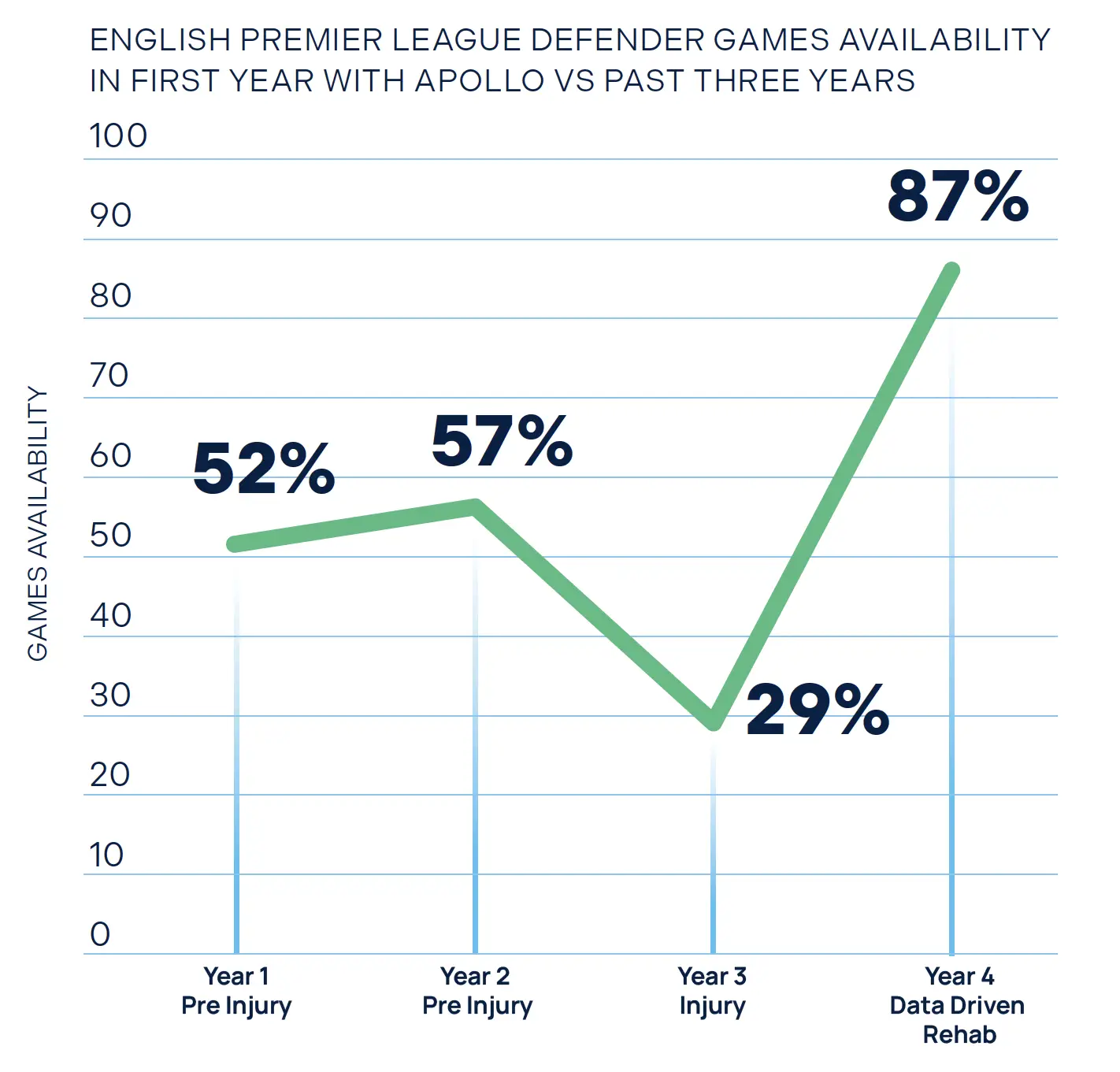
That represents an average of under half a season of football, on a declining trajectory. For a defender operating in a back line that relies on partnership and organisation, the disruption extended beyond the individual.
The core challenge was diagnostic rather than medical. The player was being assessed, treated, rehabilitated and returned to play. What could not be reliably established was why the cycle continued to repeat, or at what point in the cycle risk was accumulating. Hamstring injuries in football are seldom isolated events; they typically represent the endpoint of a trend developing over a period of weeks. Without a means of reading that trend, staff were positioned to respond to injuries rather than anticipate them.
The data required to identify the pattern already existed within the club. It was distributed across separate systems, owned by separate departments and reviewed on separate timelines. By the point that information had been collated, cleaned and reported, its value as an early indicator had diminished.
THE SOLUTION
Apollo was implemented across the club's medicine and performance function. The defender's case became one of the clearest early applications of the system.
Identifying the Root Cause
Apollo's algorithm assessed the player's data against his own historical baseline and identified a specific, measurable weakness in the right hamstring. Rather than a general recommendation to develop the posterior chain, staff had a defined target, an established baseline and a means of verifying week by week whether the intervention was producing the intended effect.
NordBord testing recorded right hamstring output through the opening block of the season:

Week-to-week variation is expected in NordBord data. The relevant measure is the trend, which rose consistently across the ten-week period and finished 32% above the week one baseline. Staff were able to confirm the programme's effect rather than infer it.
The Individual Player Risk Tracker
Apollo consolidates data from the club's separate systems onto a single player card. Availability, sleep average, movement screen score, NordBord left and right output with the corresponding left-to-right differential, high intensity sprints, maximum speed and total distance are presented together, each benchmarked against the player's positional average or previous season.
The value lies in interpretation speed. Rather than opening multiple systems and assembling a picture manually, practitioners see overall risk surfaced directly, with the contributing metrics visible immediately beneath it. This enables staff to identify and address problem areas before injury or reduced performance occurs.
Team Medicine and Performance Reporting
Alongside the individual view, Apollo consolidates squad-wide data covering availability in both training and matches, current injuries and current illnesses. The report can be toggled month by month, providing both the live position and the historical trend.
In this case, the defender's availability and the time lost specifically to injury and illness could be assessed in the context of the wider squad rather than as an isolated record.
Configured Around the Club's Existing Processes
A significant element of the implementation was fit. Apollo built the club's requested bespoke reporting formats within the platform and established APIs to move data cleanly between systems.
"The API's which Apollo have set up for us, allow far cleaner downloading, reviewing and actioning of the data collated, with multiple staff members able to access the relevant info."
- Head of Medicine and Performance
Shared access across medicine, performance and coaching staff removed a common bottleneck, in which decisions wait on whichever individual holds the data.
THE IMPACT
Game Availability
The defender's game availability reached 87% in his first season with Apollo, compared with 29% the previous season and 52% and 57% in the two seasons preceding that.
He missed 13% of games across the season, with nearly all absences occurring in the opening weeks. From the point at which his hamstring strength began to increase, he was available on a near-continuous basis.
Hamstring Strength
Right hamstring output increased across the tracked block, finishing 32% above the week one baseline. The weakness identified at the start of the season was no longer measurable as such by week ten.
Physical Output
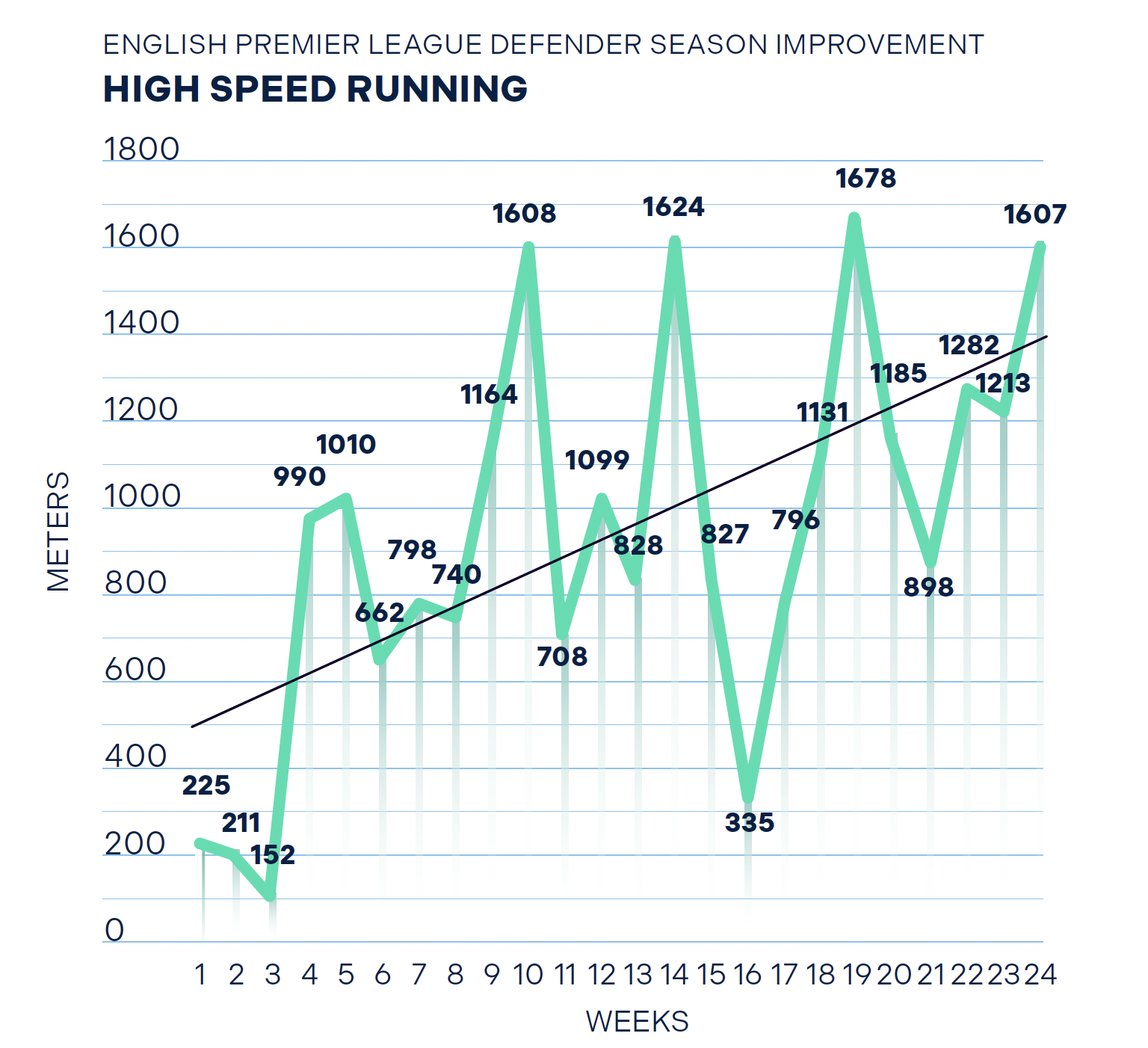
Availability was accompanied by improvement across each of the physical metrics the club tracked over the 24-week period.
Meters per minute rose from 152 in week 1 to 529 in week 24, with a consistent upward trend across the season.

High speed running rose from 225m to 1,607m, with a season high of 1,678m in week 19.
Explosive distance rose from 421m to 2,248m, with a season high of 2,392m.

Sprinting distance rose from 146m to 657m, with his highest recorded output occurring in the final week of the season.
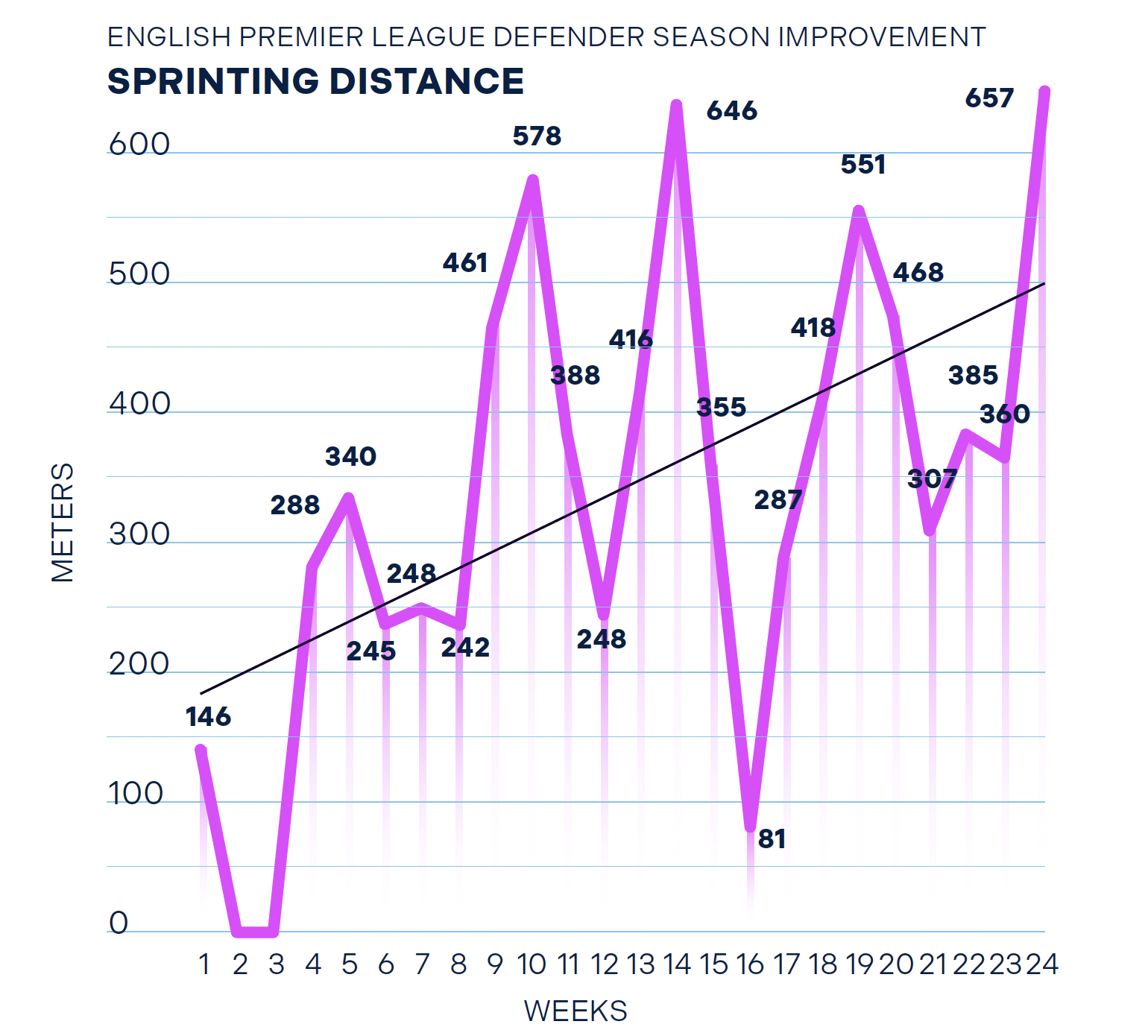
Two observations are worth noting. First, improvement occurred across strength, endurance, power and speed concurrently rather than in isolation. Second, output was still rising at the end of the campaign, indicating the player finished the season at his physical peak rather than managing a reduced load to complete it.
Departmental Outcomes
Beyond the individual case, the medicine and performance department recovered staff time. Bespoke reporting built within the platform removed manual collation work, saving man hours and improving productivity on the front line. Cleaner API-driven data flow allowed multiple staff members to access the information they required directly.
The outcome is a department spending less time assembling reports and more time acting on them, with risk visible early enough to inform intervention.
CONCLUSION
This case concerns one player over one season, following the identification of one specific weakness. The underlying principle applies more broadly.
Hamstring injuries remain the most common injury in English football, and the majority are preceded by a measurable trend that existing club data is capable of detecting. Realising that capability depends on consolidating the data, benchmarking it against the individual, and presenting it to staff within a timeframe that allows action.
See how Apollo can work for your team, contact us for a demo, email info@apollov2.com.