
Client: An Established Major League Baseball Franchise
Sport: Professional Baseball
Focus: Injury reduction, pitcher availability and performance
INTRODUCTION
Elbow injuries (UCL) are the defining fear in a Major League pitching staff. A torn UCL takes a pitcher out for a minimum of nine months, and when the pitcher in question is a team's ace, the loss reshapes a season.
An MLB franchise adopted Apollo across its front office, medicine and performance functions. Game data on pitchers was already extensive — velocity from the game gun, spin rate from video analysis, release point and angle from the club's stats system — but it lived in three separate systems, with medical data held in a fourth. Apollo's algorithm was applied to that data and identified a specific, measurable threshold in pitcher elbow extension linked directly to both injury risk and in-game performance.
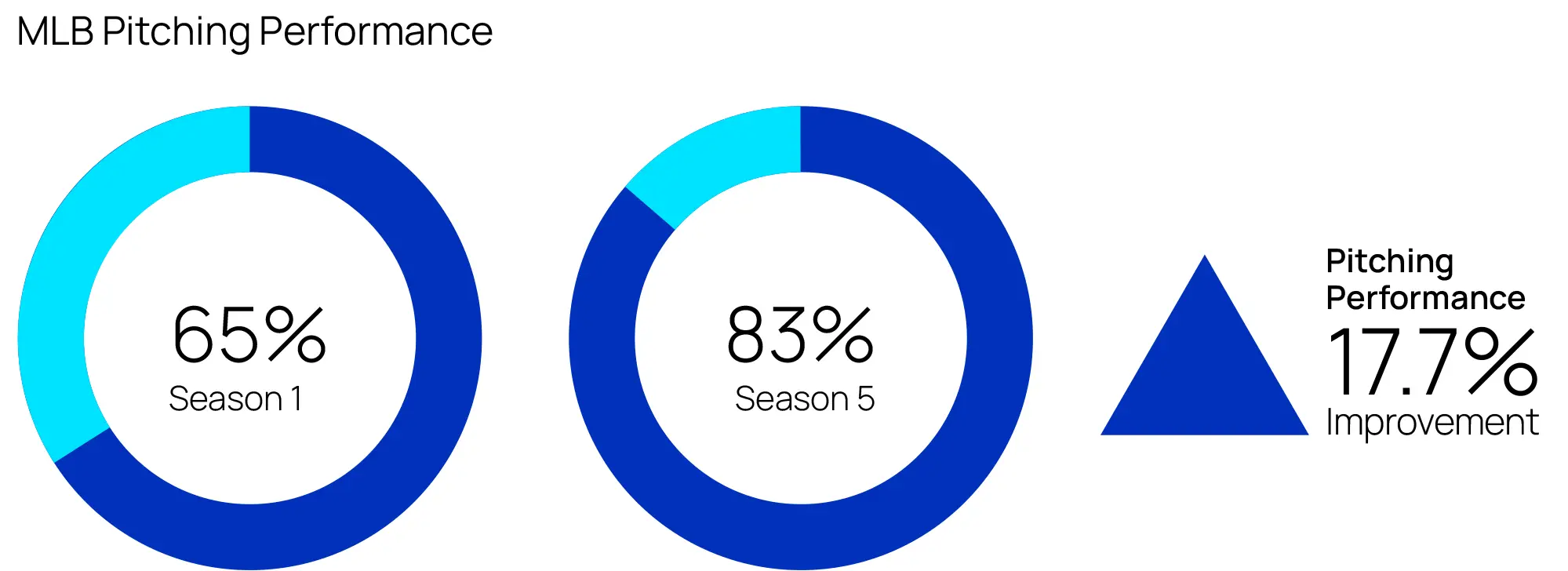
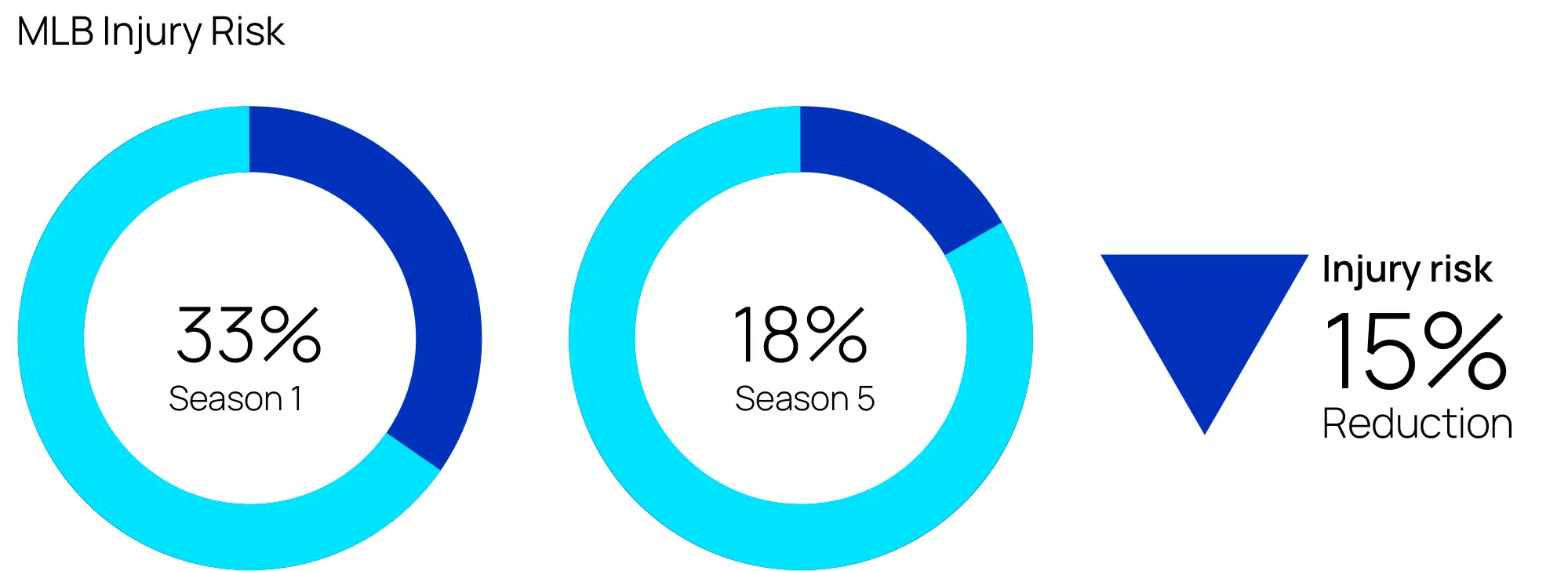
Once that threshold was built into a live dashboard, the club reduced pitching-staff injury risk by 15.5% and improved individual pitching performance by 17.7% across two seasons. The following outlines the opportunity the club identified, the challenge it faced, the approach taken, and the outcomes recorded.
THE OPPORTUNITY
MLB front offices, medical staff and coaching staff are not short of pitcher data. Game guns capture velocity, video analysis tracks spin rate, the club's stats system logs release point and angle, and the medical and training room holds its own record on top of that. The difficulty was never collection. It was that four departments were each holding a piece of the same pitcher and rarely comparing notes.
The front office reviewed game information. Medical and training staff reviewed what they saw before and after each outing. Neither was looking at the pitcher holistically, and nothing was shared live. A release point drifting week over week, or an elbow extension trending upward, carried no weight on its own inside any single system. Read together, that same trend was an early warning.
The opportunity for the club was to bring those four silos into one picture of the pitcher, and to surface that picture in-season, before a trend became an injury.
THE CHALLENGE
UCL injuries in starting pitchers were a recurring, high-cost problem for the club.
If a pitcher sustained the injury, the club lost him for a minimum of nine months. When that pitcher was a star starter, the disruption reached beyond one roster spot into the rotation, the bullpen usage plan and the season itself.
The challenge was diagnostic rather than medical. The data needed to anticipate the injury already existed inside the club's own systems: game gun velocity, video-tracked spin rate, release point and angle from the stats system, and medical and training observations. It simply wasn't being read as one dataset. By the time information from all four sources was manually compared, its value as an early warning had largely gone.
THE SOLUTION
Identifying the root cause
Apollo's algorithm analysed the club's pitching data and isolated elbow extension as the critical variable. The optimal position for pitching performance sat at 6.6 degrees of extension. When a pitcher's elbow extension moved more than 5 degrees from full extension, crossing above a 6.9 threshold, performance dropped and injury risk rose in the same games.
Specifically, extension beyond that 5-degree threshold was associated with a 15.5% increase in injury risk and a 17.7% drop in pitching performance, per game. That gave medical and coaching staff a defined, measurable target rather than a general caution about workload.
The front office dashboard
Apollo consolidated the club's separate data streams, velocity from the game gun, spin rate from video analysis, release point and angle from the stats system, and medical and training data, onto a single dashboard. Front office, medical and coaching staff could monitor the same pitcher, against the same threshold, at the same time, rather than reconciling four separate views after the fact.
The effect was a shift from reviewing what had already happened to catching elbow extension drifting toward risk while there was still time to act on it.
THE IMPACT
Season and staff-wide results
Applying the elbow-extension threshold across the pitching staff, and monitoring it through the dashboard, produced measurable results across two seasons:
Five-year results
Apollo was adopted by the club ahead of Season 1. Measured over the five seasons that followed:
- Overall pitching-staff injury rate fell 30%, even as the league average rose 30% over the same period.
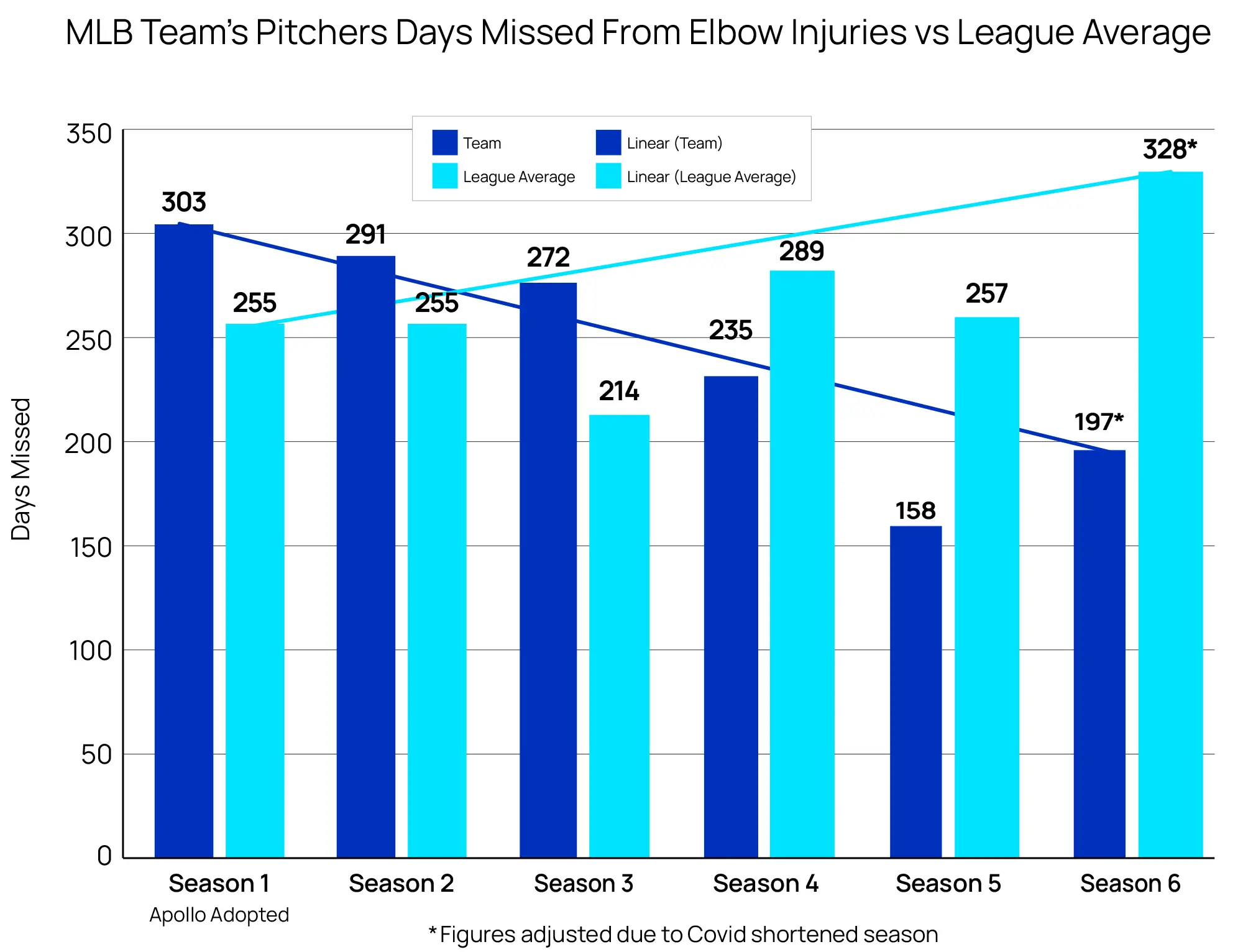
- Pitcher elbow-injury rate specifically fell 35%, even as the league average rose 29% over the same period.
Days missed to injury, overall (team vs. league average):
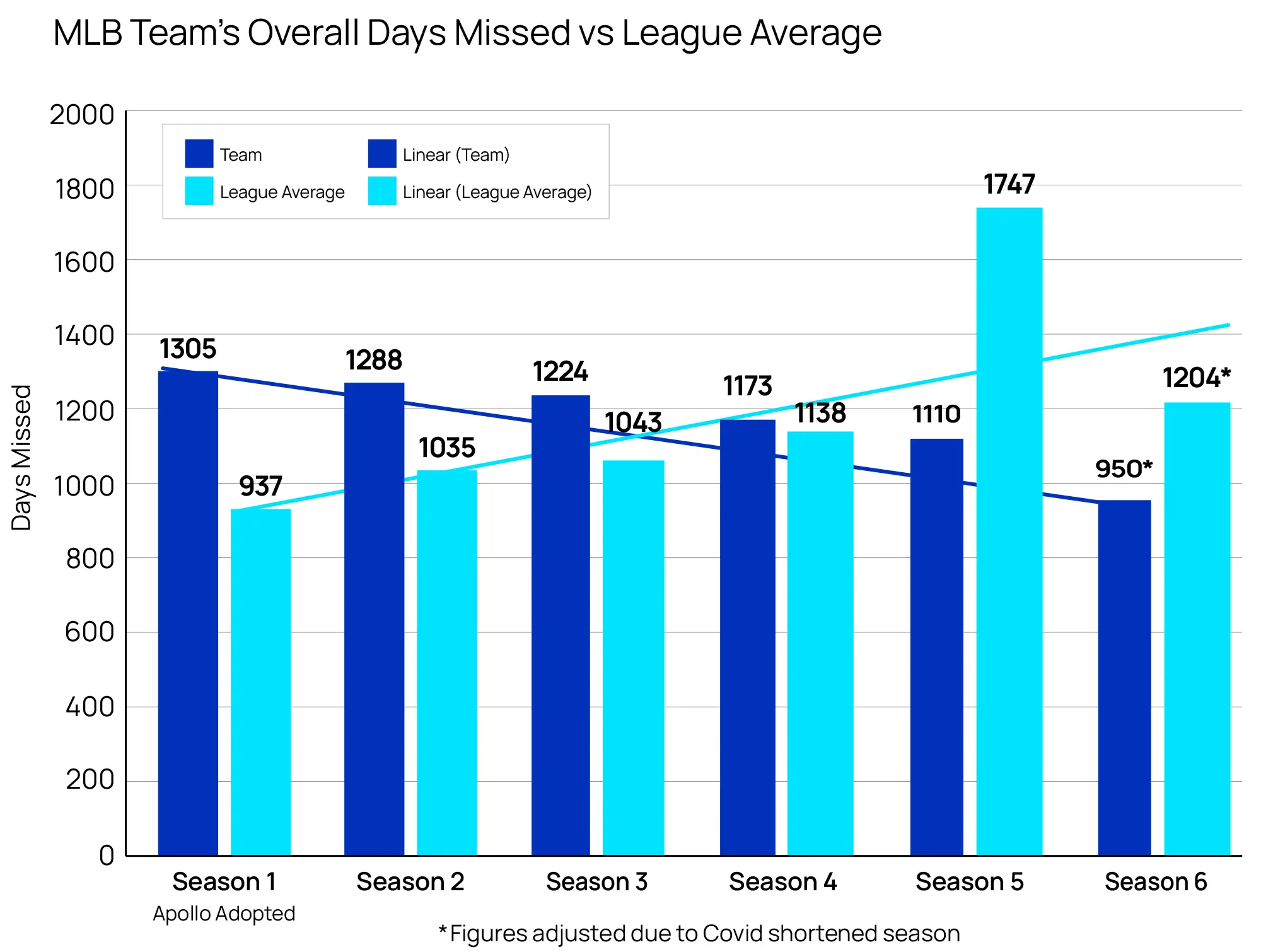
Across every year measured, the club's trend line moved down while the league's moved up.
CONCLUSION
This case concerns one measurable variable — elbow extension — surfaced from data the club already owned. The underlying principle applies more broadly.
UCL injuries remain the most costly recurring risk to a Major League pitching staff, and the data capable of anticipating them is typically already being collected — just not read as one picture. Realising that capability depends on consolidating the data across front office, medical and coaching silos, benchmarking it against a measurable threshold, and presenting it to staff in-season, before the trend becomes the injury.
See how Apollo can work for your team, contact us for a demo, email info@apollov2.com.